Each year, Historic Salem, Inc. (HSI) invites the community to celebrate excellence in preservation by nominating outstanding restoration and renovation projects for our Preservation Awards. Whether a meticulous home restoration, a period-appropriate garden, or the conservation of a historic monument, these projects stand as inspiring examples of preservation at work.
We’d like you meet our 2019 Preservation Award Recipients.
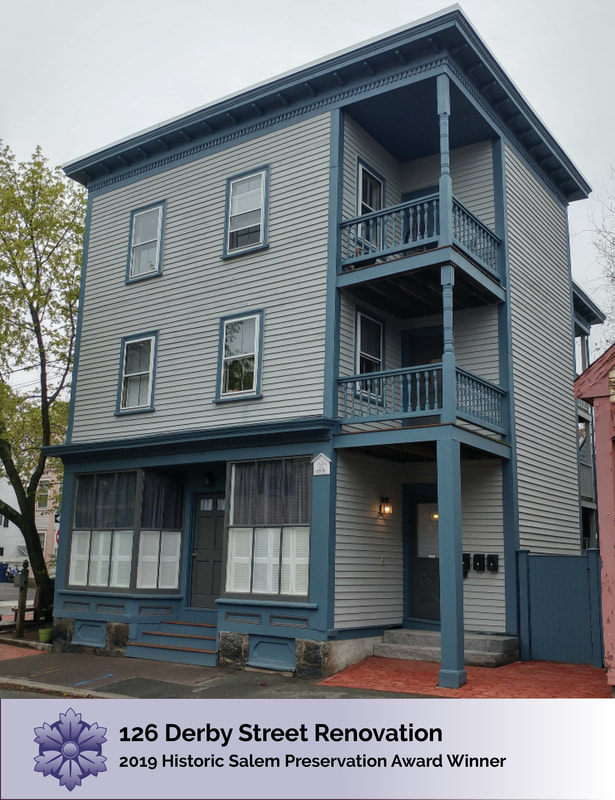
The Classical-revival style Mary and Michael Donahue House was originally constructed in 1870, with the storefront added in 1900 and the full 3rd floor in 1912. Little changed in the next 100 years and when Ben Carlson, a builder and local landlord, purchased the building in 2018 the storefront remained a notable feature of the run-down looking building – though it had been used as a residential space for many years. Mr. Carlson recognized that the once run-down building was ideally suited, both in location and layout, to provide middle income condos close to downtown. Originally, he proposed a new, altered storefront – while restoring the upper windows and repairing the wood cladding. At the urging of the Historic Commission the owner devised a plan to retain and restore the existing wooden storefront. To accommodate the need for ventilation and access for the first story unit, a new wood window was approved for the building elevation that overlooks a small corner park. The result is a restoration project that truly respects the building’s evolution from residential to commercial and back, with the option of future commercial use as the building, and Essex Street, evolve.

The former Rectory and Convent for St. James Parish (161 & 162 Federal Street, respectively) were built in the late 1800s in the midst of the growth and expansion of St. James Parish – at the time the only English speaking Catholic Church in the city. The convent was surplused in the 1970s, while the Rectory housed priests until quite recently. When Dan Botwinik, president of Cougar Capital, first saw the interior of the former Rectory he was beguiled by the original fireplaces and woodwork and acted quickly to purchase the building. Renovation was possible, in part, because of the use of Historic Tax Credits, the first such project that the team tackled, with the requisite learning curve. Then, in the midst of renovating the building into four apartment units, they were contacted by the broker for the Convent across the street. Applying lessons learned at the Rectory, the team undertook the significantly more challenging project. The Convent had been unoccupied for some time, with previous attempts to renovate stymied by environmental issues (now resolved). As a result of age and neglect the building needed major structural work to secure the building at the roof and at the foundation. Once these issues were solved the new units were constructed with original floors, fireplaces, doors and a reconstruction of a grand 6 ft wide plaster medallion in the former atrium space. In both buildings original exterior details were retained – including access through the grand front entrances, a key concern of the National Park Service review.
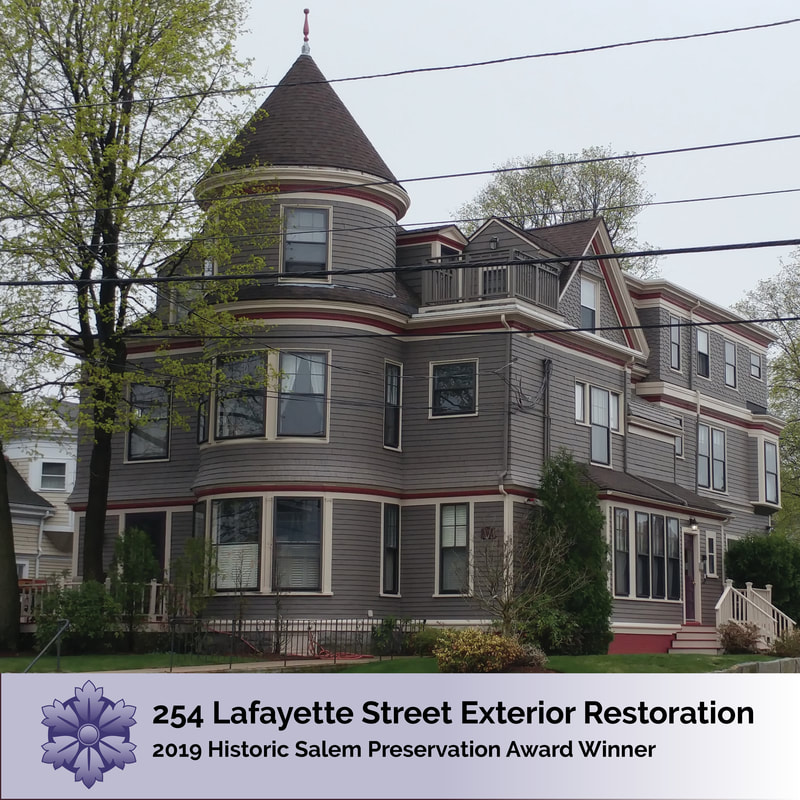
There is a high bar when it comes to evaluating a nomination for an exterior paint job. Painting is a necessary maintenance item for many homes and it can be done without much consideration. The work done at 254 Lafayette Street exceeded this high standard and sets an excellent example for an exterior renovation. Where layers of paint once hid trim details it is now removed, where unimaginative beiges covered all surfaces indiscriminately, careful consideration has now been made to showcase different materials and designs. The overall effect is a celebration of the Victorian style of the house, flaunting all the decoration and delight that the building possesses. For this building in the Lafayette historic district it is notable that the owners approached the Historic Commission with a well-thought out paint scheme in place, seeking to showcase the building style, not trying to skirt by with the minimum effort. The high bar for a quality paint job is only met when true care and effort is made to celebrate the building.

Located on the beautiful tree-lined Buffum street in North Salem, The Northfield Townhouses were carefully renovated in an effort to preserve and enhance the historic features of the 1832 Edward Melcher house. The rich new colors of the exterior add to the elegant historic feel of the building – with preserved original trim and 2 over 2 windows along the front façade. Solar panels, carefully placed to be out of view of the passerby, and many other energy conserving additions to the house reduce the carbon footprint of the home. And speaking of footprint, the original volume of the building was only subtly adjusted, hardly noticeable from the street, with the owners making the purposeful decision not to encroach on the generous side yard, maintaining the historic setting. Instead they created individual patio spaces surrounded by a custom-designed and built, period-inspired, cedar fence. Lee & Jacqueline Dearborn of The Makers Guild, Inc., with consultation from Derby Square Architects in Salem, and the help from a host of highly skilled tradesmen, worked together to achieve this successful project. We celebrate this simple act of preserving and respecting the integrity of one of Salem’s historic buildings – and its far-reaching impact as an example in future projects.
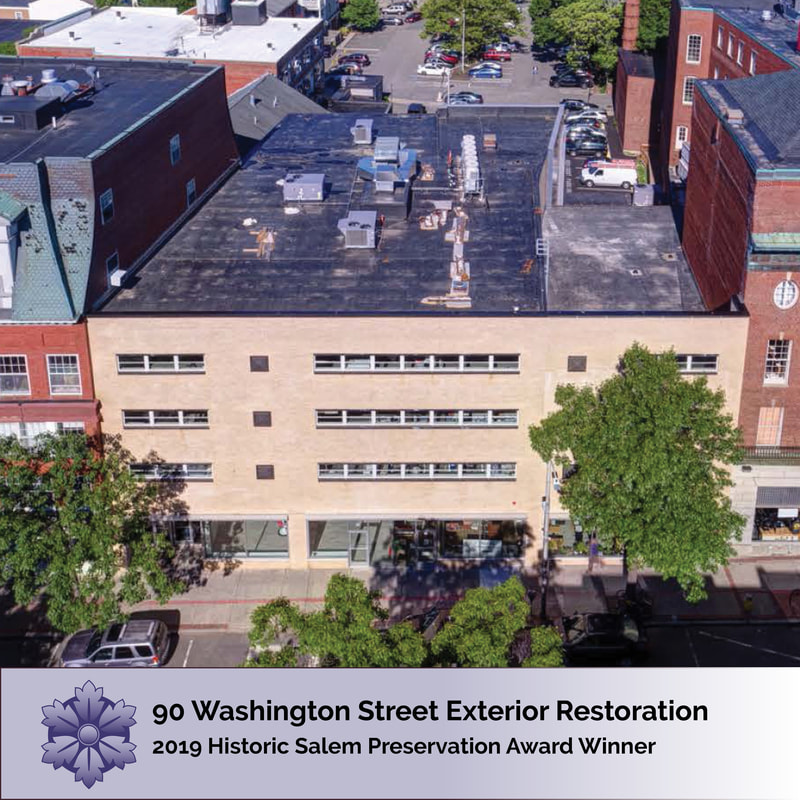
We do not take lightly Salem’s claim to four centuries of architecture. However, the architecture from the most recent century is often less loved than it deserves. Not so in this project renovating 90 Washington Street that restored this 72 year-old “youngster” of an international style building. The minimal architectural styling meant that restoration design and construction needed to carefully maintain and emphasize the simple lines and materials. This was done with repointing, window restorations and storefront simplification. The rear of the building was added onto, creating an example of how new and not-so old can work in harmony to contribute to Salem’s architectural heritage. The renovation work allowed for a lively tenant, the City of Salem, to use the interior spaces and for the three store fronts to add vibrant activity to Washington Street.

As part of Salem Alliance for the Environment’s work to protect the health and efficient use of resources in Salem they have been advocating, researching and pushing for understanding, accurate reporting, and repair of natural gas leaks throughout Salem. While preservation often focuses on the visible – and what is “pretty,” it is an honor to recognize the equally important efforts to maintain and repair the unseen aspects of our historic city. With infrastructure of all kinds surpassing 100 years of service there continues to be a need for information gathering, decision-making and prioritization of funds and efforts to ensure our current resources remain serviceable. This principle is applicable to preservation at any level. SAFE’s work is motivated by environmental concerns, with life and health concerns the driving force. A lesson to all preservationists that we would all be well served to consider how sustainability, functionality and resource management are connected to the care and viability of our historic cities.
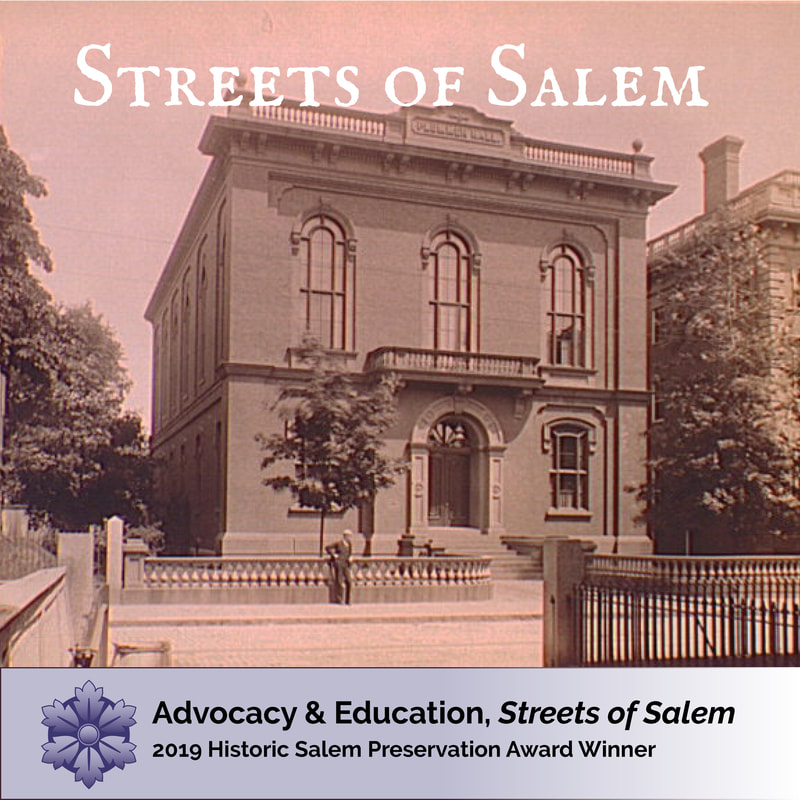
In a city full of history – and historians – Donna Seger’s Streets of Salem blog has risen to the top as an accessible online resource for a range and depth of information about Salem’s history, filtered through an intelligent, well-researched world-view. Posts range from passionate, persuasive essays to joyful celebrations of ephemera – and are written not as a lofty professor, but as if she can’t help but share her excitement, anger or delight about information she has discovered. Her educational efforts provide an important basis for preservation’s power – it is the stories and our individual and collective love of place that precede any preservation work. A side note – Donna restarted the Preservation Award program about 15 years ago after it had gone dormant for a time – so this award is a particularly meaningful one.