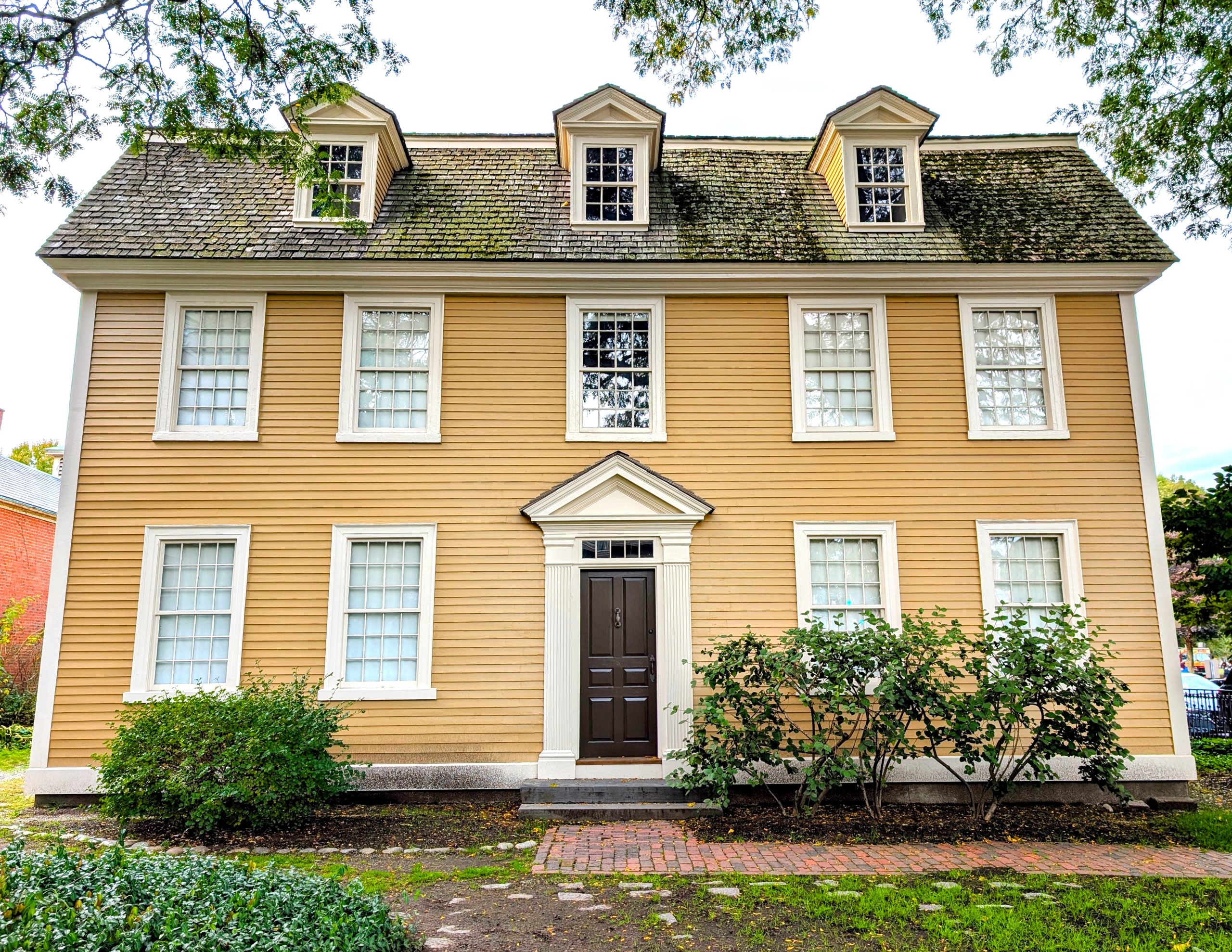
The House Relocation Database documents Salem buildings that have been moved from their original locations, a practice that dates back more than a century and is often to protect them from demolition or major redevelopment. These records show when and where each structure was relocated, providing insight into the city’s evolving streetscapes and the preservation efforts that made these moves possible.
Please note that while we hope this tool will be useful for researchers and anyone with an interest in learning more about their homes, neighborhood, or Salem in general, there are limitations to consider. First, only buildings that traveled down a public road required a permit, so there are no Council records of buildings moved within the block (like The Witch House). Finally, the accessible digitized Council records only go back to Volume 12 in 1881; earlier volumes haven’t been digitized so they can only be accessed in person at Salem City Hall.
History of Salem House Relocation
Many people are familiar with house relocation; it’s not unusual to see historical images of entire houses on top of trucks, being moved to a new location to save them from demolition. Today, when a historic house faces the dangers of a new development, the broadening of streets, or lately, environmental threats, sometimes relocation is the only option. The most well-known examples in Salem are on the historic campuses of The House of the Seven Gables and the Peabody Essex Museum (its Yin Yu Tang house must take the award for the longest distance a Salem house has traveled). Still, many other private homes across town have been moved from different locations. Historic Salem, Inc.’s own origins lie in the efforts to relocate the Nathaniel Bowditch House, our headquarters, and the neighboring Judge Jonathan Corwin House (The Witch House) after a plan to widen streets put them in threat of demolition.
Although historic preservation is the main reason to move these structures today, landowners over the past two centuries had more practical reasons to uproot their homes. Before the advent of the mass-produced prefabricated components and the popularization of building materials like masonry, metal, and concrete, it was more economical and less wasteful to move a wood-frame building rather than demolishing it and rebuilding from scratch. Before motorized vehicles, these houses were pulled by oxen or horses on wooden rollers, a long process that could damage the structure if done improperly. Yet, as the Salem city records show, the effort seems to have been worth it since in the last half of the nineteenth century, dozens of houses, barns, and outbuildings were moved across Salem each year. As Salem developed, trees, pavement, traffic, and utility cables ultimately reduced the number of houses that were moved.
HSI’s House Relocation Database
Tracking down the origins of moved houses involves a lot of time, patience, and luck, since in many cases, the only records of a house being moved are newspaper articles or surviving documents like those of the well-known Salem diarist, the Reverend William Bentley. To facilitate this research, HSI provides a database of house removal permits, based on the City Council minutes starting in 1881. During this time, any attempt to move a building on public roads required a permit issued by the City Council, so the database has almost 400 records of buildings that were moved. Within the database, one will find the date when the permit was requested and the date of response (not the actual moving date), the volume and page where the Council minutes record is located, the name of the mover or moving company, and the addresses of origin and destination. Regarding the addresses of origin and destination, not all information was fully recorded during these proceedings, so, in many cases, the addresses are missing or just the street is mentioned. Finally, it’s also important to remember that some of these streets were renumbered later, so the address today might not coincide with the address on the record.